
Virtual Assistant vs AI Automation Ecommerce
Virtual assistant vs AI automation ecommerce: learn what each does best, where each fails, and how smart sellers use both to scale profitably.
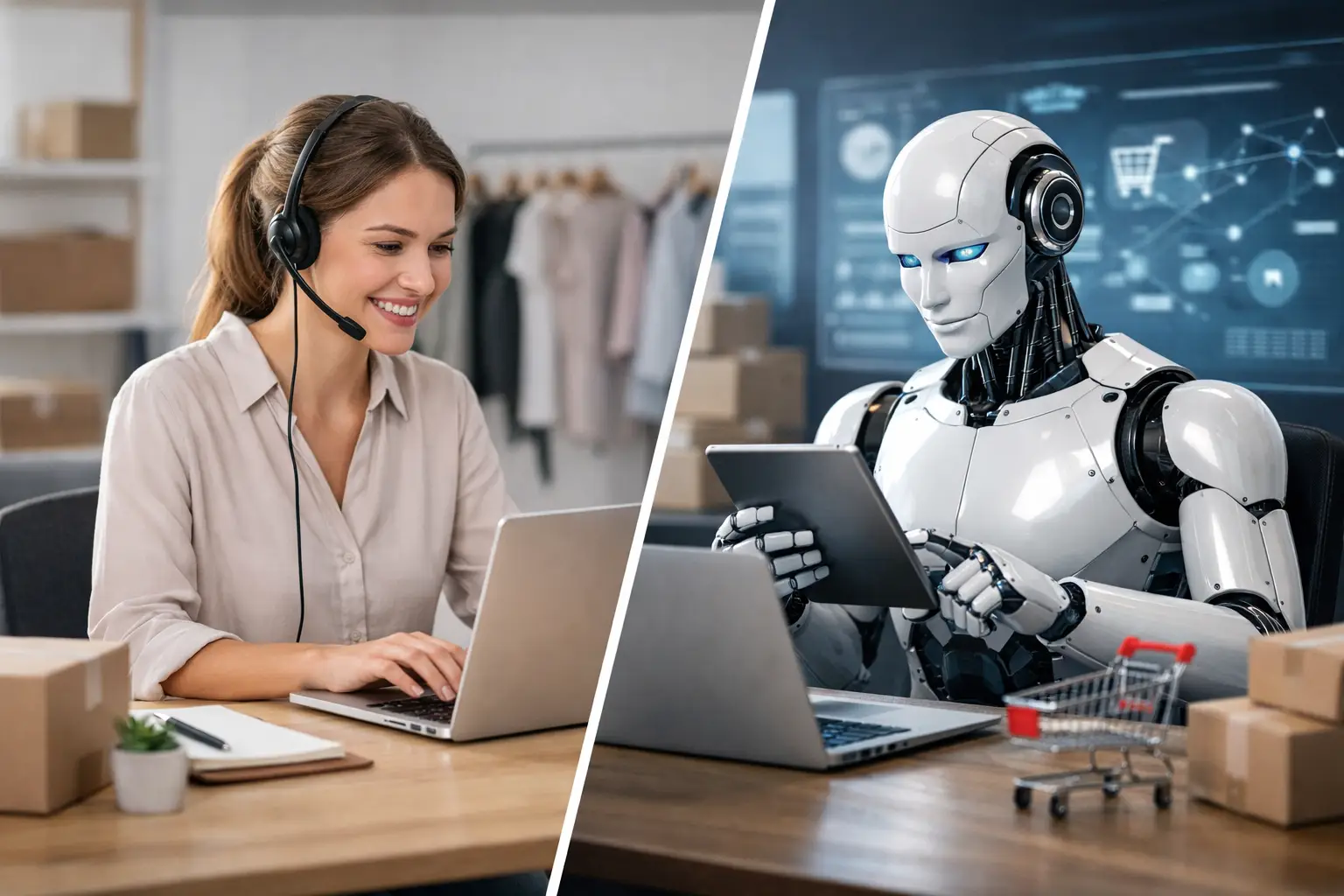
In short: the best virtual assistant vs AI automation ecommerce setup usually uses both, but for different jobs. AI is best for speed, drafting, summaries, comparisons, and repeatable logic; a virtual assistant is better for human follow-up, platform execution, supplier chasing, customer support admin, and checking work before the owner makes the final decision.
What is better for ecommerce: AI or a virtual assistant?
In short: neither AI nor a virtual assistant is automatically better for ecommerce. AI is better for fast drafts, summaries, repeatable analysis, templates, and first-pass automation; a VA is better for coordination, checking details, supplier follow-up, customer judgment, and work that needs human context.
WAH Academy’s practical answer is to use both inside an owner-led operating system. Let AI speed up repetitive work, let a trained VA execute and verify the workflow, and keep final decisions on product choice, cash flow, pricing, supplier risk, claims, and customer promises with the founder.
| Work type | AI usually fits | VA usually fits |
|---|---|---|
| Product research | Summarizing reviews, competitors, and buyer objections | Collecting screenshots, quotes, supplier details, and data for review |
| Listings and content | Drafting titles, bullets, emails, SOPs, and ad angles | Uploading, formatting, checking facts, and flagging unclear claims |
| Customer support | Drafting replies from approved policies and FAQs | Handling exceptions, tone, escalation, and follow-up |
| Operations | Turning repeatable steps into templates and checklists | Running the checklist, reporting progress, and asking the right questions |
AI vs VA decision checklist for ecommerce owners
- Use AI first when the task is repetitive, text-heavy, low-risk, and easy for the owner to review.
- Use a VA first when the task needs follow-up, judgment, platform navigation, or checking multiple sources.
- Use both when AI can prepare the draft and a VA can verify, format, upload, or report the result.
- Do not delegate final decisions on money, customer promises, product claims, supplier risk, or scaling until the owner has reviewed the evidence.
- Turn good work into SOPs so the same task can be repeated without the founder explaining everything again.
Useful related guides: AI automation workflows, delegating ecommerce operations to VAs, and a virtual assistant workflow example.
AI vs Virtual Assistant Ecommerce FAQ
What is better for ecommerce: AI or a virtual assistant?
AI is better for speed and repeatable drafts; a VA is better for execution, follow-up, checking details, and human judgment. Most ecommerce owners benefit from combining both under clear SOPs.
Should AI replace an ecommerce VA?
Not for every task. AI can reduce repetitive work, but a VA still helps with coordination, quality checks, customer nuance, supplier follow-up, and platform execution.
What should an ecommerce owner keep control of?
The owner should keep product direction, pricing, supplier risk, customer promises, refund exceptions, cash-flow decisions, and final approval on claims or strategy.
How does WAH Academy teach AI and VAs together?
WAH Academy treats AI and VAs as parts of an owner-led ecommerce system: document the work, use AI to move faster, train VAs to execute, and keep business judgment with the founder.
AI tools and virtual assistants for ecommerce sellers: the practical split
Short answer: AI tools are best for speeding up research, summaries, drafting, comparisons, and process documentation. Virtual assistants are best for repeatable execution, admin, listing support, supplier follow-ups, data clean-up, and operational tasks that still need human checking.
The strongest ecommerce operators do not ask whether AI or a VA is “better.” They decide which work needs judgment, which work needs speed, and which work needs repeatable human execution. The owner should keep strategy, product approval, cash-flow decisions, and final quality control.
- Use AI for: product research summaries, review analysis, listing drafts, SOP drafts, competitor comparison, and brainstorming test angles.
- Use a VA for: supplier outreach, listing uploads, spreadsheet clean-up, customer-service support, order/admin checks, and repeatable marketplace tasks.
- Keep with the owner: product choice, budget decisions, risk limits, brand positioning, and whether a test is worth doing.
WAH Academy teaches this as part of ecommerce business building: Amazon US plus AI tools plus virtual assistants plus guided execution. For the broader learning path, read Ecommerce Coaching in Singapore and Amazon FBA Course vs Ecommerce Coaching.
AI vs Virtual Assistant Decision Checklist
Use this quick checklist before you automate, hire, or delegate an ecommerce task:
- Use AI first when the task is research, summarising reviews, drafting listings, comparing competitors, or turning messy notes into an SOP.
- Use a virtual assistant when the task needs account access, follow-up, judgement-light execution, supplier chasing, spreadsheet maintenance, or customer-service admin.
- Keep it with the owner when the task affects product choice, pricing, reorder cash, supplier risk, brand positioning, or whether a test should continue.
- Combine AI and a VA when the VA can use AI to work faster, then check the output before it reaches customers, suppliers, or Amazon.
For the practical next layer, compare this with how to delegate ecommerce tasks that scale and how to delegate ecommerce operations to VAs.
That distinction matters fast once your store starts moving across Amazon, Shopify, social channels, and supplier communication. What feels manageable at 10 orders a day becomes messy at 50. What looks cheap as manual labor becomes expensive when delays create stock issues, customer friction, and bad decisions.
Virtual assistant vs AI automation ecommerce: the real difference
A virtual assistant gives you human judgment at a low operating cost. A good VA can follow context, make decisions inside a process, spot issues before they become expensive, and handle edge cases that software still struggles with. If you run a multi-platform business, that matters. Listings break. Suppliers send unclear updates. Customers ask questions that do not fit a script. Influencer outreach needs follow-up with a human touch.
AI automation does something different. It handles repeatable, rules-based, high-volume work with speed and consistency. It does not get tired. It does not forget steps. It can classify support tickets, generate first drafts, summarize reviews, flag inventory anomalies, and trigger actions across tools. If a task happens the same way every day, AI and automation should be your first thought.
The mistake is treating them like direct replacements for each other. They are not. A VA is labor with judgment. AI automation is leverage with logic. Strong operators use both.
When a virtual assistant wins
A VA is usually the better choice when the task requires nuance, adaptation, or accountability across several moving parts. This is especially true in ecommerce, where work often looks simple from the outside but gets messy in the details.
Customer support is a clear example. AI can answer common questions, but a trained VA can de-escalate a frustrated customer, understand intent, and protect the brand. The same goes for supplier communication. AI can draft messages, but a VA can chase a delayed shipment, clarify a packaging issue, and spot when a supplier answer sounds off.
A virtual assistant also wins when you need process ownership. If someone is responsible for checking inventory updates, coordinating product page changes, monitoring influencer responses, and escalating problems before they hurt sales, that is not just task execution. That is operational coverage.
For newer sellers, a VA can also be easier to implement than automation. You do not need a perfect tech stack on day one. You need documented steps, a basic handoff, and training. A capable VA can start producing value even if your systems are still rough.
When AI automation wins
AI automation wins when the work is repetitive, frequent, and structured. Think about all the small actions that drain a founder's day without creating strategic value. Pulling review themes. Sorting incoming emails. Drafting product descriptions from a source file. Turning customer inquiries into tagged support categories. Creating standard responses. Checking whether listing fields match your master sheet.
This is where AI starts crushing manual workflows. It reduces lag, cuts down human error, and keeps work moving after hours. For stores managing both Amazon and Shopify, automation is often the difference between reactive operations and actual control.
It also wins on scale. A VA can process one queue at a time. Automation can process hundreds of events without slowing down. If your brand is pushing traffic through Meta ads, influencer campaigns, and social content, the volume of messages, data points, and content requests can spike quickly. AI helps absorb that volume without adding headcount for every jump in sales.
There is another advantage founders often miss: consistency. Humans improvise. Sometimes that helps. Sometimes it creates avoidable mistakes. Automation gives you standardization. If margin alerts need to trigger at a certain threshold, or customer inquiries need to be routed by issue type, software will do that the same way every time.
Virtual assistant vs AI automation ecommerce by task type
The cleanest way to decide is to stop thinking in job titles and start thinking in task categories.
If the task is repetitive and rules-based, automate it first. If the task requires judgment, communication, or exception handling, give it to a VA. If the task mixes both, automate the first 80 percent and let a VA handle the last 20 percent.
Take product listing management. AI can generate first drafts, standardize bullets, clean formatting, and compare product attributes against a template. A VA should then review for accuracy, brand tone, compliance, and platform-specific context. That combination is faster and usually better than relying on either one alone.
Take customer service. AI can classify tickets, answer FAQs, suggest replies, and flag urgent messages. A VA can review unusual cases, handle emotional conversations, and identify patterns worth escalating. That setup cuts response time without sacrificing customer trust.
Take inventory monitoring. Automation can watch stock levels, reorder points, and supplier lead times. A VA can verify anomalies, communicate with suppliers, and make judgment calls when lead times slip or demand shifts.
This is the real answer to virtual assistant vs AI automation ecommerce. You do not choose one lane for the entire business. You assign the right type of leverage to the right type of work.
The trade-offs founders need to face
A VA sounds cheaper until poor training creates rework. AI sounds efficient until bad setup creates chaos at scale. Both have failure points.
With virtual assistants, the biggest risks are inconsistent output, weak onboarding, and founder dependency. If the VA only works when you are online giving instructions, you did not delegate. You created a slower version of doing it yourself. The fix is process documentation, scorecards, and clear ownership.
With AI automation, the biggest risks are blind trust and bad inputs. Automation is only as good as the workflow behind it. If your naming structure is messy, your source data is wrong, or your approval rules are unclear, AI will just help you make mistakes faster. The fix is tighter systems, smaller tests, and human review at critical control points.
There is also a timing issue. Early-stage stores often get more immediate value from a VA because there is not enough workflow volume yet to justify building automations everywhere. Once orders, SKUs, channels, and team handoffs increase, AI becomes harder to ignore because manual work starts choking growth.
The best model for scaling ecommerce
The strongest ecommerce setup is not VA only or AI only. It is layered operations.
Start by mapping recurring tasks across your week. Then split them into three buckets: automate, delegate, and founder-only. Founder-only work should stay focused on decisions that move the business forward - product strategy, offer positioning, margin control, channel expansion, and growth planning.
Automate the repetitive admin first. Then delegate exception handling and workflow ownership to a VA. This gives you speed without losing judgment.
A practical example looks like this: AI drafts customer responses, categorizes the inbox, summarizes review sentiment, and updates tracking sheets. Your VA reviews edge cases, manages supplier follow-up, coordinates listing changes, and maintains the workflow. You stay out of routine execution and step in only when a decision affects profit, inventory risk, or growth direction.
That operating model is exactly why so many sellers hit a ceiling. They hire a VA but fail to build systems. Or they add AI tools but keep broken workflows. Tools do not fix messy operations. Structure does.
For sellers building a real ecosystem across Amazon, Shopify, and off-platform traffic, the right question is not whether people or software matter more. It is how fast you can turn repeated work into a documented process, then assign it to the cheapest reliable layer.
How to decide what to do next
If you are still doing everything yourself, do not overcomplicate this. Pick one painful workflow that repeats every week. Customer service, product listing updates, influencer outreach tracking, inventory reporting, or order issue management are all good candidates.
Then ask three questions. Does this task follow repeatable steps? Does it require human judgment? Does it happen often enough to justify setup time? Your answers will tell you whether to automate it, hand it to a VA, or use a hybrid model.
This is where execution-focused brands like WAH Academy have the right philosophy: get someone or something else to do the work. Not because delegation sounds good, but because founder time should be spent on growth, not on copy-pasting updates into spreadsheets.
The sellers who scale cleanly are not the ones working the longest hours. They are the ones who build a business that runs through systems, oversight, and smart leverage. If a task can be automated, automate it. If it needs judgment, train a VA. If you are still touching everything, that is the bottleneck to fix next.
WAH Academy Mini Course
Want to understand whether ecommerce is right for your future?
Start with WAH Academy’s mini course to understand the business model, the realistic workload, the risks, and whether this path fits you before considering any larger coaching commitment.
Start Mini CourseNo guaranteed results. Use the mini course to decide whether the WAH Academy approach fits your goals and situation.
Frequently Asked Questions
What ecommerce tasks should I use AI tools for?
Use AI tools for research summaries, review analysis, listing drafts, SOP drafts, competitor comparison, idea generation, and preparing work for a human to check.
What ecommerce tasks should a virtual assistant handle?
A virtual assistant can help with supplier follow-ups, data entry, listing support, customer-service admin, spreadsheet clean-up, marketplace checks, and other repeatable tasks once the process is clear.
Can AI replace an ecommerce virtual assistant?
Not fully. AI can speed up many tasks, but a VA can still handle judgement-light execution, follow-ups, platform work, checking, and admin that requires human accountability.
Should beginners hire a VA immediately?
Usually no. Beginners should first understand the task themselves, define the process, and then delegate repeatable work. Hiring too early can create confusion if the owner does not know what good output looks like.
How does WAH Academy teach AI and virtual assistants?
WAH Academy frames AI tools and virtual assistants as support systems for ecommerce execution. They help the owner move faster, but the owner still needs to understand product validation, cash flow, supplier decisions, and business risk.